
Processing Capabilities
Expertise
Flotation
RDi operates dedicated sulfide and industrial mineral flotation rooms, each equipped with individual fume hood exhaust, dust collection, and make-up air systems to maintain safe operations and prevent cross-contamination between chemistries.
Bench-scale rougher, cleaner, scavenger, and locked-cycle flotation testing is performed for sulfide ores, oxide ores, polymetallic ores, industrial minerals, and coal. Programs are designed around each client’s specific orebody and project stage, whether early-stage scoping or detailed feasibility. Testwork includes reagent screening and dosage optimization, collector and frother selection, pH and Eh profiling, depression and activation studies, grade-recovery curve development, kinetics evaluation, and variability testing across geological domains.
Locked-cycle tests simulate steady-state plant performance by recycling intermediate streams across multiple cycles, producing the concentrate grade and recovery data required for flowsheet design, equipment sizing, and engineering studies.
Gravity Separation
RDi’s gravity separation laboratory supports a full range of density-based concentration methods for free gold recovery, heavy mineral concentration, and pre-concentration circuit evaluation.
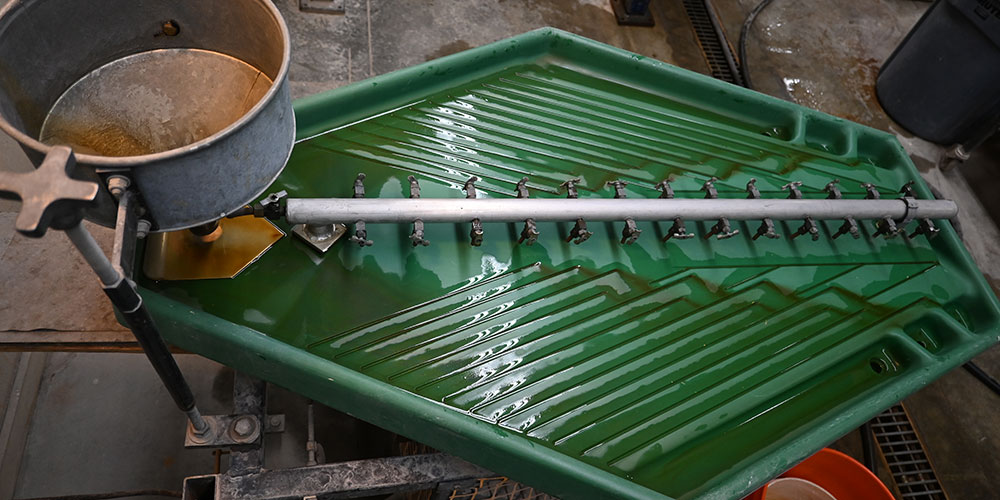
Equipment includes Knelson concentrators for centrifugal gravity recovery, spiral concentrators for continuous density separation, Wilfley, Deister, and Gemeni shaking tables for fine particle concentration, and heavy-liquid separation for sink-float analysis and cut-point determination. Testwork programs are designed to evaluate gravity-recoverable content, establish optimal grind size for liberation, define upgrade ratios and mass pull, and generate the engineering data needed for circuit design and scale-up. Gravity separation is frequently integrated with flotation or leaching programs to evaluate combined flowsheet options and maximize overall recovery.
Leaching
RDi’s leaching laboratory supports a full range of hydrometallurgical extraction methods for precious metals, base metals, critical minerals, and industrial applications. The laboratory includes dedicated leach rooms with fume hoods, individual exhaust systems, and temperature-controlled environments for sustained test campaigns.
Testwork methods include bottle roll testing for rapid kinetics evaluation, agitated leach testing for process optimization, column leach testing in diameters ranging from 4 inches to 24 inches for heap leach simulation and scale-up, vat and diffusion leach testing for coarse particle applications, and diagnostic leaching for sequential mineral characterization and reagent response. Programs are conducted using cyanide, acid, alkaline, thiosulfate, and specialty reagent systems depending on ore mineralogy and client objectives.
Leach programs are designed to determine extraction kinetics, optimize reagent consumption, evaluate grind size sensitivity, assess the impact of pre-treatment methods such as pressure oxidation or roasting on refractory ores, and generate the engineering parameters required for flowsheet development, feasibility studies, and plant design. RDi also performs cyanide destruction, and metals precipitation testing to support downstream water treatment and tailings management requirements.
All
Capabilities